
Open source store platforms sit between a Shopify subscription and building from scratch: no licence fee, your own data, and no cut of your sales, in exchange for looking after the site yourself. WooCommerce, PrestaShop, OpenCart, Magento Open Source and Drupal Commerce all cover the basics, and differ mainly in how much hosting resource they need.
On this page ▾
Running a store on a SaaS platform like Shopify works well until it doesn’t. Monthly fees climb as you add features, transaction charges eat into margins, and you’re built into someone else’s product roadmap.
Starting from nothing is not the alternative. Open source ecommerce platforms sit between the two: you host the software where you like, move it when you want, pay no licence fee, and control how the store looks and behaves. For a growing business, that control is often what separates the right platform from the convenient one.
The trade-off is that the site is yours to look after. This covers the platforms worth attention in 2026 and, honestly, what each one needs to run properly.
Why go open source?
All of these cover what you would expect from a store platform: payment processing through the major providers, inventory management, and extensions for anything beyond the basics. What differs is who carries the responsibility.
- No platform fees. The software is free. Your costs are hosting, a domain and any premium extensions you add. For a small store that usually works out cheaper than a SaaS subscription.
- You own the data. Your store, your database, your customer records. Want to move? Move.
- Customisation without a ceiling. You have the source code. If it does not do what you need, it can be changed.
- No platform cut of your sales. SaaS platforms often take a percentage on top of your payment gateway’s fee. Open source platforms do not, so you pay only what your payment provider charges.
The flip side is real. Updates, SSL, server performance, backups and security patches all need managing. A good host handles much of that at server level, and managed hosting reduces the burden considerably, but the application itself is still yours to maintain.
Worth knowing the alternative honestly: hosted platforms such as Shopify, BigCommerce, Wix and Square Online bundle a builder, payments and marketing into one monthly fee. They are simpler to start and they gate useful features behind higher tiers. That is a fair trade if you would rather not think about infrastructure, and a poor one if you intend to own the stack long term.
WooCommerce
WooCommerce is not a standalone platform. It is a plugin that adds ecommerce to WordPress, and that distinction matters more than it sounds. If you already run WordPress, you are adding a storefront rather than rebuilding anything.
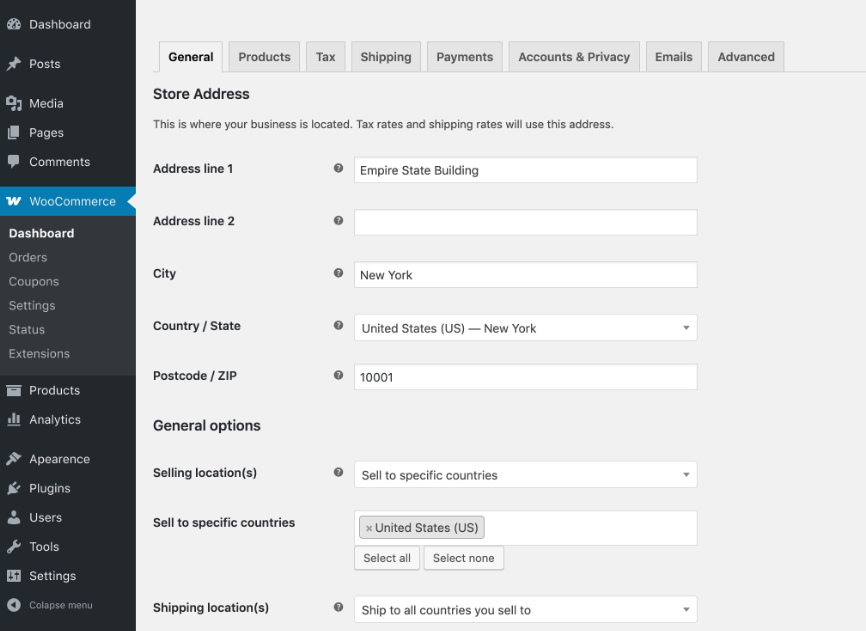
At around 29% market share among the top million ecommerce sites as of early 2026 (BuiltWith), it is the most widely used platform on the web. That brings a large extension library, plenty of themes and an active community, which in practice means someone has already hit whatever problem you are about to hit.
It runs fine on standard hosting for smaller catalogues. Thousands of products, heavy traffic or complex product configurations do better on WordPress hosting or a VPS with dedicated resources.
- Strengths
- Huge extension library, built on software most people already know, low barrier to entry, handles physical goods, digital products and subscriptions.
- Weaknesses
- Performance degrades on shared hosting as the catalogue grows. Plugin conflicts are a genuine risk once you stack extensions. Not purpose-built for commerce, so some things need workarounds.
- Best for
- Small to medium businesses, existing WordPress users, catalogues under a few thousand products.
Our guide to the free WooCommerce plugins worth running covers what to add once it is installed, including the UK payment and shipping side.
PrestaShop
PrestaShop is a dedicated ecommerce platform built on the Symfony PHP framework, not bolted onto a CMS. It was designed to run a shop, and that focus shows in built-in multi-currency support, catalogue management and a modular architecture where you add only what you need.
It has a strong presence in Europe, which makes it worth a look for UK businesses selling internationally. PrestaShop puts its own installed base at more than 250,000 merchants. Its admin is more opinionated than WooCommerce’s, which cuts both ways: less fiddling to get a working store, less flexibility without modules.
It runs on standard PHP hosting, so a cPanel plan is enough. Be aware that many of the more useful modules are paid, so the free platform can become expensive once you fill the gaps.
- Strengths
- Purpose-built for commerce, strong multi-currency and localisation, large module marketplace.
- Weaknesses
- Many modules cost money. Weaker content management than WordPress. Official support requires a paid subscription.
- Best for
- Businesses wanting a dedicated platform without the WordPress layer, particularly selling across currencies or regions.
OpenCart
OpenCart is a PHP platform with a clean admin and a straightforward approach. Its standout feature is multi-store: you can run several separate storefronts from one admin panel, each with its own domain, theme and catalogue.
The extension marketplace is large, though quality across it varies enough that the headline count matters less than checking the specific extension you need. It runs on standard PHP and MySQL, so most shared plans will take it.
Where it falls short is built-in SEO and content capability. If organic search is central to your growth, expect to add extensions to fill those gaps. There is also no official support, so you are relying on community forums and documentation when something breaks, which is worth knowing before you commit a business to it.
- Strengths
- Multi-store from one dashboard, large extension marketplace, lightweight, runs on modest hosting.
- Weaknesses
- Weak built-in SEO. No official support. Extension quality varies considerably.
- Best for
- Businesses running multiple storefronts, or anyone wanting a lighter alternative to WooCommerce without the WordPress dependency.
Magento Open Source
Magento is what you graduate to when a store outgrows everything else. The open source edition remains free, and the paid version is Adobe Commerce.
The feature set reflects that audience: complex product types, advanced pricing rules, multi-warehouse inventory and B2B selling, all out of the box. The API is well documented, which makes it a strong choice for headless setups where the storefront is decoupled from the backend.
The cost is resource demand, and this is not a small caveat. Magento is not a platform you run on shared hosting. It needs a VPS at minimum, ideally with dedicated resources, plus Elasticsearch or OpenSearch, Redis for caching and a properly configured PHP environment. The learning curve is steep, and without development experience or budget for a developer it will be frustrating to set up and worse to maintain.
One thing worth weighing if you are choosing for the long term: the open source edition sits inside Adobe’s commercial ecosystem, where the paid product is the strategic priority. That does not make it a bad choice today, and it is a reasonable question to ask about a platform you expect to run for five years.
- Strengths
- Enterprise feature set, strong API, handles complex catalogues and B2B, large developer community.
- Weaknesses
- Heavy resource requirements. Steep learning curve. Slow without proper caching and configuration. Impractical for small stores.
- Best for
- Established businesses with large catalogues, B2B sellers, and anyone with the development resources to support it.
Drupal Commerce
Drupal Commerce is an ecommerce module for Drupal. If your site already runs on Drupal, or you need content and commerce tightly integrated, it earns consideration. Drupal’s content management is stronger than most dedicated ecommerce platforms, which is a real edge when editorial content and products carry equal weight.
It is popular with larger organisations, and Cartier use it, which says something about capability at scale. It connects to external systems well through its RESTful API, and the community, while smaller than WordPress’s, is technically strong.
The barrier is higher than WooCommerce or PrestaShop. Drupal has a steeper curve than WordPress, and building a store means assembling multiple contributed modules rather than installing one plugin. Realistically you need a developer or agency to get it off the ground.
- Strengths
- Excellent content management, strong API, good for content-heavy commerce, flexible architecture.
- Weaknesses
- Steep learning curve. Requires assembling modules. Smaller community. Not for non-technical users.
- Best for
- Content-driven ecommerce, organisations already on Drupal, sites where editorial and sales matter equally.
How to choose
The honest version is that this is mostly decided by where you are starting from rather than by feature comparison.
WooCommerce is the default for most UK small businesses, and particularly if you already use WordPress. You get the whole WordPress ecosystem alongside a well-tested commerce layer.
PrestaShop if you want a dedicated platform without the WordPress layer, especially selling across multiple currencies.
OpenCart if you are running several storefronts from one admin, or want something lighter.
Drupal Commerce if content marketing drives the business and the store sits inside a larger content site.
Magento when you have genuinely outgrown the others: large catalogues, B2B requirements, thousands of SKUs, and the technical resource to match.
Key takeaways
- The licence is free; hosting, security and updates are your responsibility.
- WooCommerce is the most accessible option for UK small businesses.
- PrestaShop and OpenCart run on standard PHP hosting and suit those wanting a dedicated tool.
- Magento needs a VPS and development expertise. It is not a small-store platform.
- Your hosting matters as much as the platform. A well-configured server makes every one of these perform better.
That last point is the one people get to last. Page speed, uptime and server response all start below the application, and none of these platforms can compensate for a server that is already at its limit. WooCommerce, PrestaShop and OpenCart all run well on ecommerce hosting, while Magento needs the dedicated resources of a VPS or Magento hosting.


